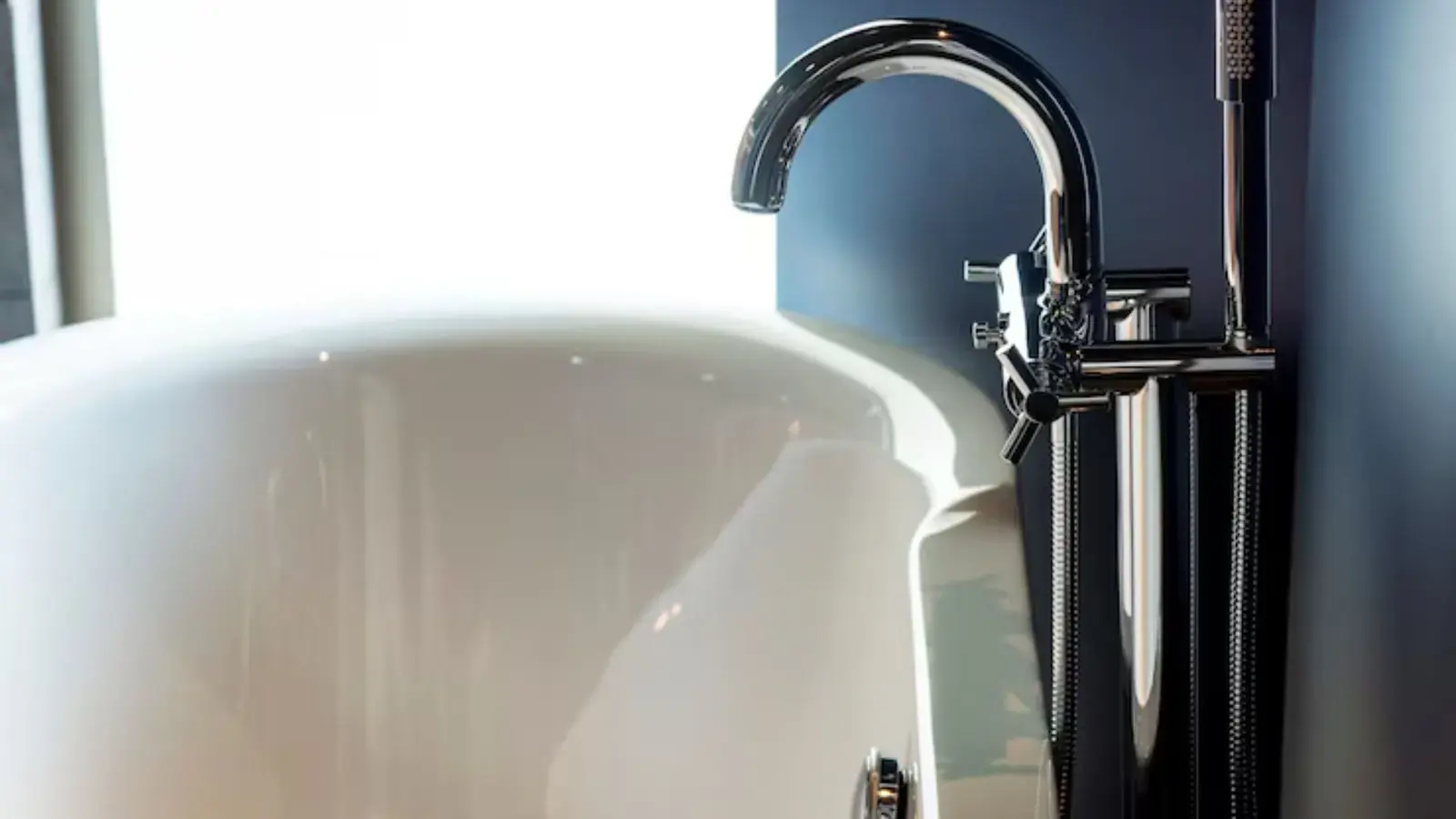
What your tub faucet is telling you
Most tub faucet problems start inside the valve behind the wall. A drip from the spout, a handle that is hard to turn or a shower that goes hot and cold all trace back to a worn part in that valve.
| Symptom | Likely cause | Common fix |
|---|---|---|
| Drips from the spout after shutoff | Worn cartridge, washer or seat | Replace the cartridge or washer |
| Handle stiff or loose | Corroded stem or loose set screw | Clean, tighten or replace the stem |
| Hot and cold swings | Worn pressure-balancing cartridge | Replace the cartridge |
| Water at the wall | Leaking valve body or connection | Open the wall and repair |
Know which kind of valve you have
Tub faucets use compression, cartridge, ball or ceramic disc designs. A compression faucet has separate hot and cold handles that screw down on a washer, and a single-handle faucet usually uses a cartridge.
The brand and model decide which parts you need. Remove the handle and look at the cartridge, then match it by photo or by the number stamped on it before you buy a replacement.
SafetyScalding and temperature swings
A shower that goes suddenly hot is more than a nuisance, especially for children and older adults. Set your water heater to about 120 degrees Fahrenheit to reduce scalding risk, and replace a pressure-balancing cartridge that no longer holds a steady temperature.
If the temperature changes when someone flushes a toilet or runs the washing machine, the cartridge or the supply pressure may be at fault. A plumber can test both and tell you which.
DIY repairSteps to replace a cartridge
Shut off the water
Use the shutoff valve or the main, then open the faucet to drain.
Remove the handle
Take off the cap and the screw, then pull the handle off.
Pull the cartridge
Remove the retaining clip or nut and pull the cartridge straight out.
Install a matching one
Grease the O-rings, seat the new cartridge and reassemble.
Protect the tub with a towel, because a dropped tool can chip the finish. If the cartridge will not move, stop before you force it, because a seized valve body can crack.
Hard partsWhen the repair is more than a cartridge
A valve body that is corroded, a missing shutoff or a leak inside the wall means the job is bigger. Accessing the valve may require opening the wall from behind or removing tile.
A plumber will tell you whether an access panel is available. If a leak is inside the wall, early action prevents rot and mold. Our faucet and fixture repair page explains what is typical, and a hidden leak may call for leak detection.
PreventionKeeping a tub faucet working longer
Turn handles gently and avoid cranking them past the point where the water stops. Forcing a handle compresses the washer or scores the seat inside the valve, and that is how a small drip starts.
Wipe mineral deposits off the spout and showerhead every few months with a vinegar-soaked cloth, and clear the aerator or diverter if flow is uneven. Tell a plumber about any handle that has become stiff, because stiffness is often the first sign of a corroding stem.
If your tub and shower share a valve, a worn cartridge affects both. Replacing the cartridge on a schedule, rather than waiting for a failure, can stop temperature swings before someone gets scalded.
ChecklistBefore you take the handle off
- Shut off the water at the fixture stops or the main valve.
- Put a towel in the tub to catch screws and protect the finish.
- Photograph each step so you can reassemble in the right order.
- Bring the old cartridge or a clear photo of it to the store.
- Have a spare set of O-rings and plumber's grease ready.
Taking a few photos as you go is the habit that separates a clean repair from a pile of parts. Faucet makers use different retaining clips, set screws and stem designs, and an hour of guessing is easy to avoid when you can look back at the previous step.
MistakesMistakes to avoid when repairing a tub faucet
Forcing a stuck handle or cartridge can crack the valve body, which turns a cheap repair into a wall repair. If a part will not move with steady pressure, stop and ask a plumber.
Buying a part without matching it is the other one. Cartridges look alike but differ in length, splines and seals, so compare the old part to the new one before you install it.
EmergencyFaucet that will not shut off
If water will not stop, shut the main water valve and call. A tub faucet that keeps running can overflow the tub and flood the floor below.
Do not wait to see whether it stops. A bathtub fed by a failed valve can pour out gallons an hour, and the damage grows with each hour.
Euless notes on water and wear
Euless buys its main water supply from the Trinity River Authority, which draws from Cedar Creek and Richland Chambers reservoirs, and also runs city wells in the Trinity Aquifer, according to the city's public works page. Minerals in water can build up inside cartridges over time, and the content varies by source.
To learn what is in your water, read the city's annual water quality report and test your tap. If scale is a recurring problem, our softener and filtration page explains the options.
Questions about bathtub faucet repair in Euless
A worn cartridge, washer or seat is the usual cause. Replacing the part stops the drip.
Often, if you can reach the cartridge and the valve body is sound. If the valve is corroded or the leak is behind the wall, call a plumber.
A worn pressure-balancing cartridge is the usual cause. Replacing it restores steady temperature.
Mineral buildup can shorten the life of cartridges. Test your tap and read the city's water quality report to see what applies.
For a leaking spout or wall valve, call about faucet and fixture repair. For a leak you cannot find, try leak detection. We also serve Hurst, and our Euless homepage has the rest of the service area.