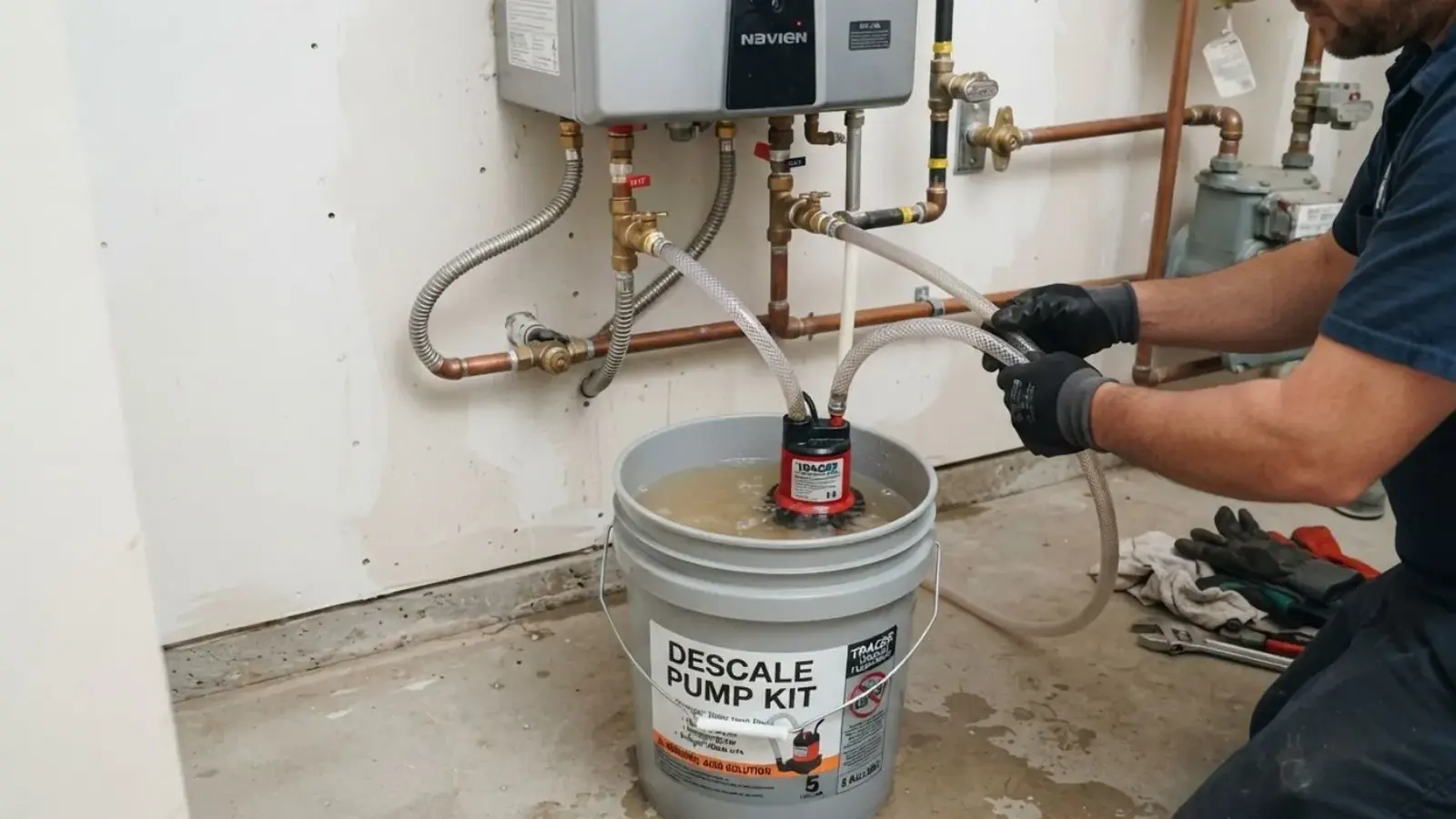
Why a tankless heater needs flushing
Water carries dissolved minerals, and heating it causes some of them to settle out as scale. In a tankless unit the scale forms inside the narrow passages of the heat exchanger, where it restricts flow and insulates the metal from the water.
Scale lowers efficiency, raises the temperature the exchanger runs at and eventually triggers error codes or failure. A flush dissolves the scale with a mild acid solution and rinses it out before it does that damage.
How oftenSetting a flush schedule
Manufacturers commonly recommend a yearly flush, and hard water shortens the interval. The right schedule depends on your water, so test your tap and read the city's report before you decide.
| Water | Suggested approach |
|---|---|
| Soft or moderate water | Follow the maker's yearly schedule |
| Hard water | Flush more often, consider a softener |
| Unknown | Test your tap, then choose |
A softener protects the heat exchanger and may be worth considering, as explained on our softener and filtration page.
The processHow a tankless flush works
Shut off power and gas
The heater is isolated before service.
Close the service valves
Hot and cold isolation valves are closed.
Connect a pump and hoses
A small pump circulates descaler through the unit.
Circulate and rinse
Solution runs for about an hour, then the system is rinsed.
Units installed with service valves are quick to flush. Units without them need valves added first, which is an inexpensive upgrade that makes every later service easier.
Do it yourselfCan you flush it yourself
Some homeowners flush their own units with a pump, hoses and white vinegar or a descaling solution recommended by the maker. If you do, follow the manual, shut off gas and power first and clear the inlet screen when you finish.
A plumber can also check the vent, the screens and the error history in the same visit. If the unit is not flowing well after a flush, there may be another problem such as a failing sensor.
Gas or electricDifferences between gas and electric tankless flushes
Gas units have a burner, a vent and a combustion system, so a service visit also looks at the burner, the flame sensor and the vent connections. Electric units have heating elements and a control board instead, and scale can coat the elements directly.
Either type uses the same basic flush, with a pump circulating solution through the heat exchanger. The extra checks are where a plumber adds value, because a vent leak or a dirty flame sensor will not show up in a flush alone.
If the unit has a built-in inlet filter screen, clear it each time. A clogged screen mimics the symptoms of scale and is a five-minute fix.
SolutionsVinegar or a commercial descaler
White vinegar is the common homeowner choice and works well for light scale. A commercial descaler is stronger and may be needed for heavy buildup, but it must be compatible with the heat exchanger material, so check the manual before using one.
Never mix cleaning products, and never use a descaler that the maker does not approve. After the flush, run clean water through the unit until the smell of vinegar is gone, then check for leaks at the service valves before you restore power and gas.
Warning signsSigns scale is building up
Water takes longer to get hot
Scale slows heat transfer.
Temperature swings
Flow through the exchanger is uneven.
Error codes
Sensors read overheating or low flow.
Noise from the unit
Scale and boiling can cause rumbling.
If you see these signs, flush the unit and look at the water. Our tankless water heater page covers repairs and installation as well.
ChecklistWhat you need for a tankless flush
- A small submersible pump and two hoses with the right fittings.
- A five gallon bucket and enough white vinegar to cover the pump intake.
- Isolation valves on the hot and cold lines, or a plan to add them.
- The manual for your unit, for any model-specific steps.
- A towel and a flashlight for the service valves.
If any item on this list is missing, a plumber can supply it and handle the flush in about an hour. For a unit that has never been flushed, a plumber can also check how heavy the scale is and whether the unit has been running hot.
MistakesMistakes to avoid when flushing a tankless unit
Skipping the manual is the first. Some heat exchangers do not tolerate certain descalers, and a wrong product can cause damage that voids a warranty.
Leaving the service valves in the wrong position after the flush is the other. Check that the valves are fully open, the gas and power are back on and the unit fires normally before you leave it.
Local notesWater in Euless and what to ask
Planning a tankless install or a maintenance schedule starts with the water you actually have.
Euless notes on water supply
Euless buys its main water supply from the Trinity River Authority, which draws from Cedar Creek and Richland Chambers reservoirs, and the city also operates wells in the Trinity Aquifer, according to its public works page. The mix can change, and so can the mineral content at your tap.
The city posts annual water quality reports. Read the latest, test your own tap and use the results to set a flush schedule, and ask your plumber about a softener if the numbers are high.
Questions about flushing a tankless heater in Euless
Many makers recommend once a year, and hard water calls for more often. Test your tap to decide.
A small pump, hoses and white vinegar or a descaler recommended by the maker. Follow the manual.
Scale builds up, efficiency drops and the unit can overheat, show error codes or fail early.
They make a flush much easier. A plumber can add them if the unit has none.
To plan a service visit, see tankless water heater service. If scale is a house-wide issue, read about water softener and filtration. We also serve Hurst, and our Euless homepage lists the rest of the area.