Find out what is in your water first
A filter solves specific problems. Chlorine taste and odor, sediment and some chemicals respond to a carbon or sediment filter, and mineral hardness responds to a softener, which is a different device.
Buying a system before you know the problem is how people end up with equipment they do not need. A home test kit or a lab test shows your hardness, chlorine, iron and other values, and the city's annual water quality report shows what is delivered to the neighborhood.
TypesSediment, carbon and other filters
| Filter type | Helps with | Does not do |
|---|---|---|
| Sediment | Sand, silt and particles | Taste, hardness |
| Activated carbon | Chlorine taste and odor, some chemicals | Hardness, dissolved minerals |
| Softener (not a filter) | Mineral hardness and scale | Taste, sediment |
| Reverse osmosis (point of use) | Many dissolved substances at one tap | Whole-house flow |
Many homes use a sediment and carbon whole-house filter for general water quality, and a reverse osmosis unit under the kitchen sink for drinking water. If hardness is the problem, our softener and filtration page explains the difference.
InstallationWhat a whole-house install involves
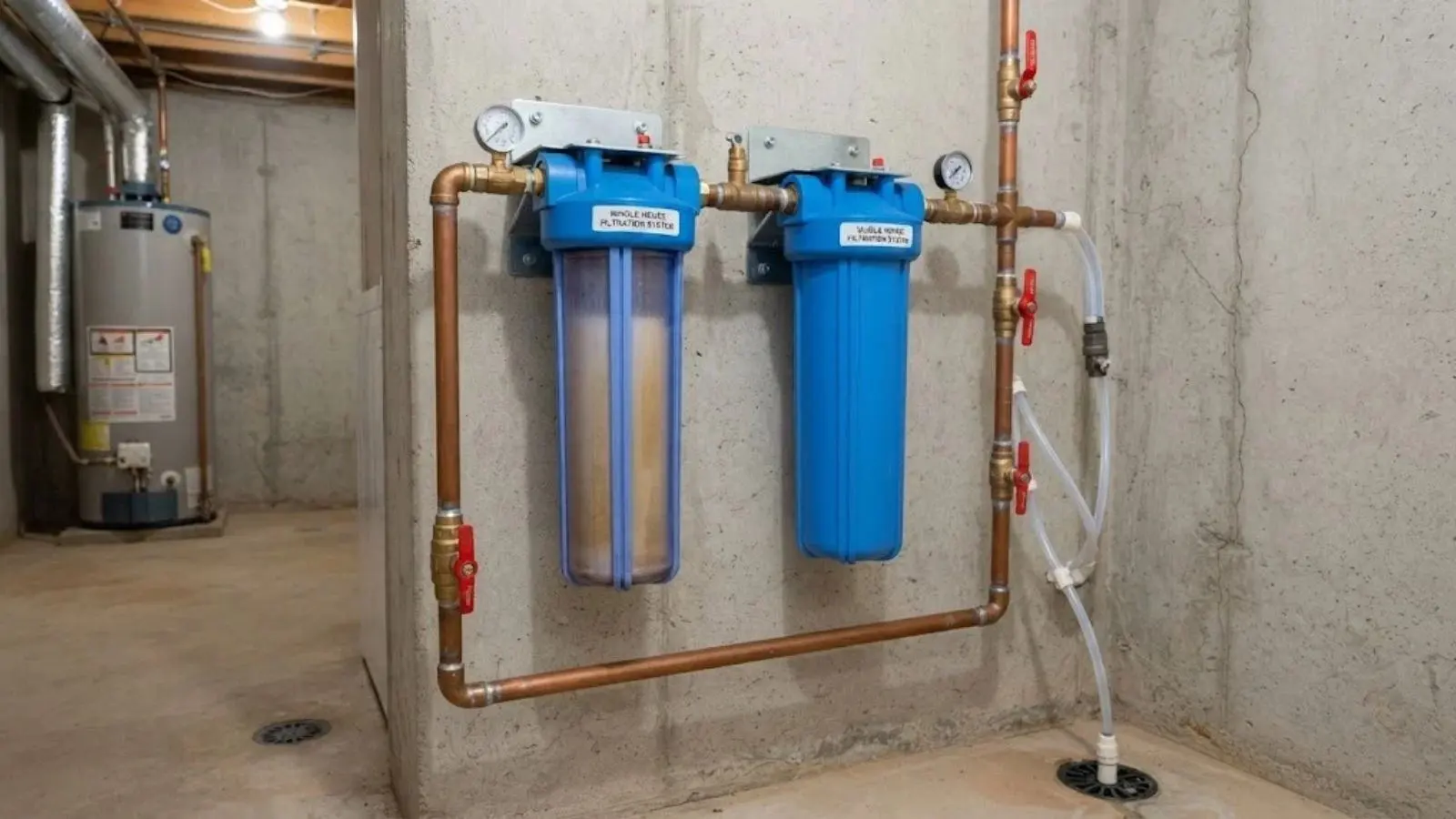
The filter installs on the main supply line after the shutoff, usually in a garage, utility room or outside wall. A bypass valve lets you isolate it during maintenance, and pressure gauges before and after show when the filter clogs.
Choose the location
A dry spot with space to change cartridges.
Cut into the main
Install the housing with a bypass.
Test for leaks
Check pressure and every joint.
Flush and set the schedule
Rinse the new cartridge and note the change date.
A plumber also checks the house water pressure, because a filter adds a small pressure drop. A clogged cartridge can cut flow through the entire house.
UpkeepCartridges, backwashing and maintenance
Cartridge filters need new cartridges on a schedule, often every three to twelve months depending on the water and the type. Backwashing filters clean themselves on a timer, and still need periodic service.
Write the change date on the housing and set a reminder. A filter left too long can restrict flow and in some cases grow bacteria in the housing.
MythsCommon myths about home water filters
A filter does not make hard water soft, and a softener does not remove chlorine taste. A filter that claims to do everything usually does each job at a basic level.
Another myth is that a filter is a set-and-forget device. Cartridges clog, and a neglected filter can restrict flow and let contaminants through. Treat it like a car's oil filter, with a schedule and a record.
Bottled water is not always safer than tap water, and a filter is not a substitute for a boil-water notice when the city issues one.
CostWhat affects the cost of a whole-house system
A short checklist before you buy
- Read the city's latest annual water quality report.
- Test your own tap for hardness, chlorine and iron.
- Decide what problem you want to fix, such as taste, scale or sediment.
- Compare a whole-house system with a filter at the kitchen sink.
- Ask what the upkeep costs per year, not just the install price.
People who follow this order tend to buy the right system once. People who skip it often end up with a carbon filter bought for a scale problem or a softener bought for a taste problem, and then pay again to fix the mistake.
MistakesMistakes to avoid when buying a filter
Buying on a salesperson's in-home test is risky, since a quick demonstration can make ordinary water look bad. Use your own test and the city's report before you decide.
Forgetting upkeep is the other. A system with an annual cost you did not expect is a poor value, so ask for the yearly price of cartridges or salt before you sign.
If a salesperson will not put the system size and the upkeep cost in writing, treat that as your answer and ask a plumber for a second opinion.
AlternativesWhen a point-of-use filter is enough
If the only concern is drinking water taste, a filter at the kitchen sink or a refrigerator filter is cheaper and simpler than a whole-house system. Whole-house systems make sense when you want filtered water at every shower and tap, or when sediment is damaging appliances.
If the complaint is scale on fixtures, a softener or conditioner, not a carbon filter, is the right tool. Our plumbing installation page covers the hookup of either.
Euless notes on water quality reports
Euless buys its main water supply from the Trinity River Authority, which draws from Cedar Creek and Richland Chambers reservoirs, and the city also operates wells in the Trinity Aquifer, according to the city's public works page. The city publishes annual water quality reports, and its page lists reports going back to 2001.
Read the latest report before you buy a system, then test your own tap. Water at your house can differ from the water leaving the treatment point, because of pipes in the house and the age of the plumbing.
Questions about water filtration in Euless
It depends on what you want to fix. Read the city's water quality report and test your tap to see what applies to your home.
No. A filter removes particles or chemicals, and a softener removes the minerals that cause scale.
Often every three to twelve months, depending on the type and the water. Follow the maker's schedule.
A clean filter causes a small drop. A clogged one can cut flow noticeably, so change cartridges on schedule.
If scale is your main complaint, see water softener and filtration. For hookups and new lines, call about plumbing installation. We also serve Hurst, and our Euless homepage lists the rest of the area.